See where AI recommends your competitors, and why.
Track the buyer questions that shape purchase decisions, understand why competitors are selected, and turn every visibility gap into an evidence-backed action.
No credit card · Runs in seconds · No signup to see your score
What we check
Is your site built to be cited by an AI assistant?
Assistants can only recommend what they can parse, trust and quote. We fetch your homepage and score it against the structural signals that make a page usable as an answer.
Answerable page structure
Schema and structured data
FAQ and question coverage
Source and citation signals
Then: track the answers themselves
Readiness is the starting point. Inside TrackGeo, your buyer questions run against real assistant APIs on a schedule, so you can see which ones you win, who replaces you, and which sources shaped the answer.
The free audit checks how ready your site is to be cited by AI. It doesn’t run live AI prompts. Live competitor and buyer-question monitoring starts after signup.
Losing isn't a score. It's a specific question, lost to a specific competitor, for a reason you can read.
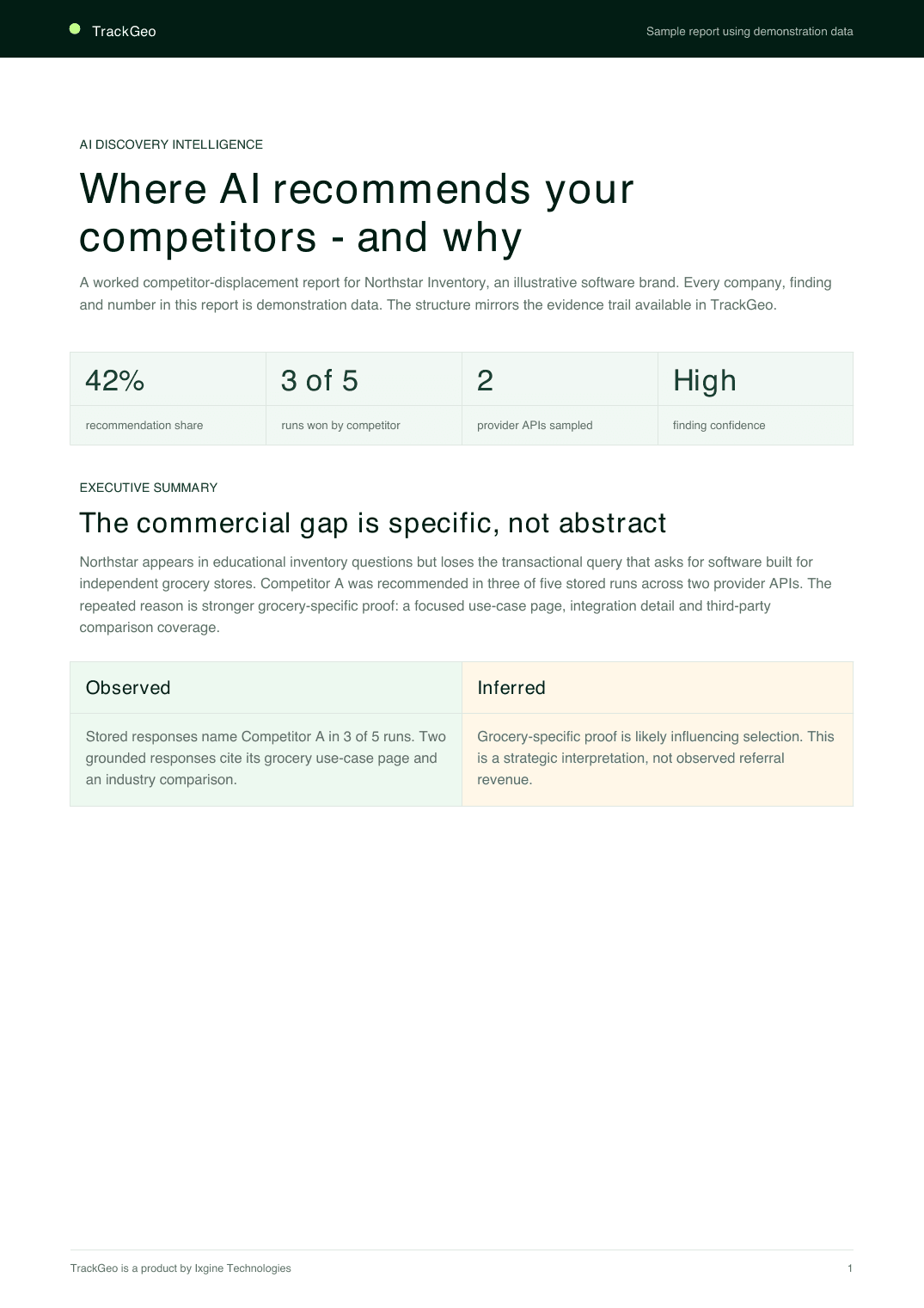
A visibility percentage tells you that something is wrong. It doesn't tell you what to do on Monday. TrackGeo takes every lost buyer question apart: who won it, what the assistant said, which sources it leaned on, and what's missing from your side.
“Best inventory software for independent grocery stores”
High
Who wins it: Competitor A
Recommended in 3 of 5 stored runs. Grounded responses cite their grocery use-case page, integration detail, and independent comparison coverage.
Your gap
No grocery-specific proof page was found on your site, and no comparison content answers this evaluation question directly.
Recommended action
Publish a grocery-specific use-case page with implementation proof and integration detail, then recheck the affected prompt after launch.
High confidence · 5 runs · 2 engines · United States
Illustrative example of the Where We Lose workflow. Findings in your workspace are generated from your own prompt runs.
Inside TrackGeo
See the whole product, not just a score.
The competitor report, share tracking and buyer-question monitoring: the surfaces your team actually works in.
Recommendation share, who won each buyer question, and the citations behind every finding.
app.trackgeo.ixgine.space/report
Sample data
The product
Three views. One decision trail.
TrackGeo keeps the question, answer, evidence and next action connected, so insight does not die in a dashboard export.
Buyer-question portfolio
Know which questions are worth winning
Group prompts by buyer intent, funnel stage, engine and market. Separate category education from the questions that influence a shortlist.
Best inventory software for independent grocers
Transactional
Losing
How to reduce grocery stockouts
Commercial
Visible
Inventory forecasting software comparison
Comparison
Absent
Competitor displacement
See who replaces you and the evidence behind it
Open the stored answer, inspect cited sources, and compare the proof an assistant found for the winner with what it found for you.
Recommended brand
Competitor A
3 / 5 runs
Supporting source
Industry comparison
Captured
Your category proof
No specific page
Gap
Action Centre
Turn a finding into owned work
Prioritise the page, proof or positioning change, assign an owner, and recheck the affected question after implementation.
Build grocery use-case page
High impact
Assigned
Add integration evidence
Medium effort
In progress
Recheck affected prompts
After launch
Queued
Sample interface using demonstration data.
Outcomes
Move from visibility scores to decisions
A number that goes down doesn't tell you what to fix. These three questions do.
Know where you stand
Track which commercially important buyer questions mention your brand, ignore it, or recommend a competitor instead.
Prompt-level monitoring
Multi-engine visibility
Region splits
Historical trends
Confidence on every finding
Understand why competitors win
See the claims, citations, source types and content patterns that keep pulling competing brands into the answer.
Competitor displacement
Citation analysis
Source classification
Claims and positioning
Head-to-head comparison
Know what to do next
Turn every gap into a prioritised action your content, SEO, product marketing or comms team can actually pick up.
Action Center
Affected prompts per action
Impact and difficulty
Ownership
Before/after tracking
Pricing
Know what a check costs before you choose a plan
Plans and prices come from the live billing catalogue. New workspaces receive a 14-day Professional trial; after the capped free snapshots are used, Free becomes read-only.
Audits, displacement analyses and Gap Sprint reports also use the shared credit pool at their published rates.
FAQ
Questions worth asking before you trust a number
What is TrackGeo?
TrackGeo measures how AI assistants answer the buying questions in your category. It tracks whether you get mentioned, which competitors get recommended instead, which sources the answer leaned on, and what to change to improve your position, with the underlying response kept as evidence.
What is AI visibility?
AI visibility is how often, and how favourably, your brand appears when an assistant answers a question a buyer would actually ask. It is not a keyword ranking. There is no position one, and no single answer everyone sees, which is why it has to be measured by repeated sampling rather than a lookup.
Which AI engines are supported?
TrackGeo measures 6 surfaces: ChatGPT via the OpenAI API, Perplexity via its sonar API, Gemini, Claude via the Anthropic API, Azure OpenAI, and Gemini with Google Search grounding. Importantly, these are provider APIs, the models behind the assistants, not scrapes of the consumer apps. We do not read Google AI Overviews from a search page, and we say so rather than implying otherwise.
How are prompts selected?
You can write prompts yourself, import them, or start from suggestions generated for your brand and category. The prompts that matter are the ones with commercial intent, so they are classified by intent and funnel stage, a comparison question and a definition question are not worth the same effort.
Why are repeated runs important?
Language models are non-deterministic: ask the same question twice and you can get two different answers, with different brands named. One response tells you almost nothing. Running a prompt repeatedly, over time and across engines, is what separates a real pattern from a coincidence.
How is confidence calculated?
Confidence reflects sample size and consistency, how many runs a finding is based on, across how many engines, over what window, and how stable the result was. Every finding shows its sample so you can judge it yourself. A result from a handful of runs is labelled as such rather than presented as fact.
Can TrackGeo guarantee AI rankings?
No. Nobody can, and you should be sceptical of anyone who says otherwise. Assistants change models, prompts and grounding without notice, and their outputs vary run to run. TrackGeo shows you what is happening, what changed, and what evidence supports a recommended action. The outcome is not ours to promise.
How are competitors detected?
Competitors are detected from the answers themselves, the brands assistants actually name in response to your prompts, combined with the competitor set you define. That means you find rivals you did not know you had, not just the ones already on your list.
Can agencies manage multiple clients?
Yes. Each client gets an isolated workspace with its own brands, prompts and competitors. Workspace count is the plan lever: Professional includes 2, Growth includes 5, and Enterprise is unlimited. White-label reporting is available on Growth and Enterprise.
Can TrackGeo connect with GA4 or Google Search Console?
Not yet. The ingestion is built and the entitlement is reserved for Professional and above, but there is no way for you to connect an account today, it is in development, and we would rather say so than let you buy a plan for it. What does work now is TrackLink attribution for assistant referral traffic. Ask us on the contact page if this is a deciding factor and we will tell you where it actually stands.
How do credits work?
One credit is one answer check: a single prompt, on a single engine, in a single region. So 10 prompts across 3 engines in 1 region costs 30 credits per run. Monthly allowances are Essentials 500, Professional 18,000 and Growth 135,000, which is sized for daily scanning at each plan's prompt and engine limits. Unused plan credits do not roll over; purchased top-up credits never expire and are only spent once the monthly allowance is gone.
Is a free audit available?
Yes, with no signup and no card. The audit on this page fetches your homepage and scores whether it is structured to be understood and cited by an assistant, and shows the buyer questions we would track for you. It is a readiness check of your site, it does not query the assistants themselves. That happens inside your workspace, where runs are attributed to your plan.
Are scheduled client reports available?
No. TrackGeo currently provides an email digest, an in-app brief, on-demand HTML reports and CSV exports. It does not execute scheduled client reports or production PDF exports, so those are not sold as available features.
How is customer data handled?
Authentication runs through Zitadel OIDC with httpOnly session cookies rather than tokens in browser storage. Workspaces and brands are isolated, access is role-based, and you control how long prompts and responses are retained. Prompts are sent to the model providers listed on our engines page in order to run them; we hold no security certifications today and do not claim any.
Find the AI buyer questions your competitors are winning
Start with a free audit of your site today, or talk to us about monitoring your brand, market and competitors continuously.